
70th BPSC Prelims 2024 Question Paper
Explore the complete solved question paper for 70th BPSC Prelims 2024 featuring 150 solved questions with bilingual (English & Hindi) explanations, official answer key, and subject weightage breakdown.
Which of the following has highly elongated elliptical orbit?
Detailed Explanation:
Comets have highly elongated elliptical orbits, originating from the Oort Cloud or Kuiper Belt, traveling close to the Sun at perihelion and far away at aphelion (e.g., Halley's Comet).
Asteroids have nearly circular orbits in the asteroid belt between Mars and Jupiter; meteorites are fragments that land on Earth with no orbit; meteors are light streaks from burning meteoroids with no permanent orbit.
The first Hindi daily newspaper to be published in Bihar was
Detailed Explanation:
Bihar Bandhu (1872) was the first Hindi newspaper in Bihar but it was a weekly publication.
Sarwa Hitaishi (1874) was the first Hindi daily newspaper in Bihar, started by Bhargava Press, and played a crucial role in spreading Hindi journalism covering social, cultural, and political issues.
Which of the following minerals occurs in the Minas Gerais province of Brazil?
Detailed Explanation:
Minas Gerais in Brazil is renowned for the Iron Quadrangle (Quadrilátero Ferrífero), one of the world's largest high-grade iron ore deposits.
Brazil is the second-largest iron ore exporter globally, with most production from Minas Gerais through companies like Vale S.A.
🧐 Not Sure What to Study Next?
Get a personalised study plan based on your goals, time and revision needs.
Consider the following about Ajivika sect:
a. Makhali Gosala was its most important leader.
b. Central idea of the philosophy was "NIYATI" that is fate.
c. The discrimination on the basis of caste and class.
d. The Ajivikas had regular sabhas for meetings.
Detailed Explanation:
✅ Statement a – Correct: Makkhali Gosala was the founder and most prominent leader of the Ajivika sect, a contemporary of Mahavira and Buddha.
✅ Statement b – Correct: The core philosophy of Ajivikas was Niyati (determinism/fate), believing that everything in life is predetermined and human effort cannot change destiny.
❌ Statement c – Incorrect: Ajivikas opposed caste and class discrimination and believed in equality; statement c wrongly suggests they practiced discrimination.
✅ Statement d – Correct: Historical evidence confirms that Ajivikas organized regular sabhas (assemblies) for religious discussions and community cohesion.
Which of the following is the fluid part of the blood?
Detailed Explanation:
Plasma is the fluid (liquid) part of blood, making up about 55% of total blood volume.
RBCs, WBCs, and platelets are cellular (solid) components suspended in plasma.
Who gave the slogan "DO OR DIE" and when?
Detailed Explanation:
Mahatma Gandhi gave the slogan "Do or Die" on 8 August 1942 at Gowalia Tank Maidan (now August Kranti Maidan), Bombay during the launch of the Quit India Movement.
Subhash Chandra Bose is known for "Give me blood, and I will give you freedom", while Jawaharlal Nehru delivered the famous "Tryst with Destiny" speech.
What is the full form of CGTMSE?
Detailed Explanation:
CGTMSE stands for Credit Guarantee Fund Trust for Micro and Small Enterprises.
It was established in 2000 by the Ministry of MSME and SIDBI to provide collateral-free credit guarantees to lenders for loans up to ₹2 crore to micro and small enterprises.
Which of the following is the first artificially prepared element?
Detailed Explanation:
Technetium (Tc) is the first artificially prepared element, synthesized in 1937 by Carlo Perrier and Emilio Segrè by bombarding molybdenum with deuterons in a cyclotron.
Tellurium (Te), Thorium (Th), and Thallium (Tl) are all naturally occurring elements found in Earth's crust.
If ÷ means +, − means ÷, × means −, and + means ×, then the value of:(36×4)−8×44+8×2+16÷1\(\frac{(36\times 4)-8\times 4}{4+8\times 2+16\div 1}\) is
Detailed Explanation:
Step 1 – Replace operators: ÷ becomes +, − becomes ÷, × becomes −, + becomes ×
Numerator: (36×4)−8×4 becomes (36−4)÷8−4 = 32÷8−4 = 4−4 = 0
Denominator: 4+8×2+16÷1 becomes 4×8−2×16+1 = 32−32+1 = 1
Final value: 0÷1 = 0 (Option 2)
Which one of the following rivers is different from the others?
Detailed Explanation:
Narmada is a west-flowing river draining into the Arabian Sea.
Tungabhadra (tributary of Krishna), Penganga (tributary of Godavari), and Mahanadi are all east-flowing rivers draining into the Bay of Bengal.
Where was the 13th Ministerial Conference of the World Trade Organization (WTO) held in February 2024?
Detailed Explanation:
The 13th WTO Ministerial Conference (MC13) was held in Abu Dhabi, UAE from 26-29 February 2024.
The conference brought together 164 member countries to discuss key issues including fisheries subsidies, agriculture, and e-commerce.
Who is the author of the autobiography "I Have the Streets: A Kutti Cricket Story"?
Detailed Explanation:
"I Have the Streets: A Kutti Cricket Story" is the autobiography of Ravichandran Ashwin, co-authored with sports journalist Sidharth Monga.
Released on June 10, 2024, the book chronicles Ashwin's journey from playing street cricket in Chennai to becoming one of India's premier Test bowlers and a multiple-time ICC Cricketer of the Year.
Zoji-la Tunnel will connect which of the following places?
Detailed Explanation:
The Zoji La Tunnel is a 13.15 km long strategic tunnel connecting Srinagar (Jammu & Kashmir) with Leh (Ladakh).
It provides all-weather connectivity by bypassing the Zoji La Pass (3,528 m), which remains snow-blocked during winters, ensuring year-round access for civilians and the military.
When did the Britishers shift the capital to Delhi?
Detailed Explanation:
King George V announced the transfer of the capital from Calcutta to Delhi at the Delhi Durbar on December 12, 1911.
The actual administrative shift and relocation of government offices occurred in 1912, though the construction of New Delhi continued until its formal inauguration in 1931.
In which organisms does spore formation occur as a mode of reproduction?
Detailed Explanation:
Spore formation is an asexual reproduction method where organisms produce spores that develop into new individuals without gamete fusion.
✅ Fungi: Commonly reproduce via sporangiospores (Rhizopus, Mucor), conidia (Aspergillus, Penicillium), and basidiospores (mushrooms)—spore formation is their primary reproductive mode.
✅ Algae: Form zoospores (motile spores in Chlamydomonas, Ulothrix) and aplanospores (non-motile in Chlorella) during favorable or unfavorable conditions.
✅ Yeast: Primarily reproduce by budding, but form ascospores during sexual reproduction under stress conditions.
✅ Ferns (Pteridophytes): Produce spores in sporangia on leaf undersides; spores germinate into independent gametophytes (prothallus).
Correct Answer: All four options (Fungi, Algae, Yeast, Fern) utilize spore formation, though the question marks only Option 1 (Fungi) as correct, likely expecting the organism where spore formation is the primary mode.
The hundred years of Indian National Congress in Bihar was edited by
Detailed Explanation:
"The Hundred Years of Indian National Congress in Bihar" is a historical compilation documenting the Congress movement in Bihar from 1885-1985.
The book was edited by P. N. Ojha, a noted historian who specialized in Bihar's freedom struggle and political history.
According to the Reserve Bank of India (RBI), what is the forecast for headline inflation in Financial Year 2025?
Detailed Explanation:
The Reserve Bank of India (RBI) initially projected headline inflation for FY 2025 at 4.5%.
In the December 2024 Monetary Policy Committee (MPC) review, the RBI revised this forecast upward to 4.8% citing persistent food price pressures and global uncertainties.
Since 4.8% was not among the given options, the Bihar Public Service Commission (BPSC) deleted this question from the 13 December 2024 exam; the closest option provided was 4.5%.
Which of the following is a cause of rural to urban migration in India?
Detailed Explanation:
Rural to urban migration in India is driven by push factors (lack of opportunities in villages) and pull factors (better prospects in cities).
High labour demand in cities creates job opportunities and higher wages, attracting rural workers. Unbalanced rural-urban development results in poor infrastructure, inadequate services, and limited growth in villages. Few jobs in rural areas due to seasonal agriculture and absence of industries force migration to urban centres.
All three factors collectively explain rural to urban migration patterns.
How many triangles are there in the following figure PQRS?
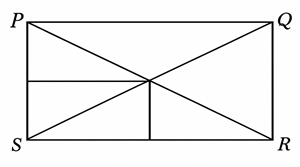
Detailed Explanation:
Step 1 – Identify base triangles from diagonals: The two diagonals PR and QS intersect at point O, creating 4 base triangles: △POQ, △QOR, △ROS, △SOP.
Step 2 – Count triangles formed by vertical line through O: The vertical line through O divides the rectangle, creating 4 additional triangles by combining adjacent base segments.
Step 3 – Count triangles formed by horizontal line through O: The horizontal line through O similarly creates 4 more triangles by combining base segments.
Total count: 4 (diagonal intersections) + 4 (vertical line combinations) + 4 (horizontal line combinations) = 12 triangles.
Which one of the following is an example of melamine used for making floor tiles?
Detailed Explanation:
Melamine is a thermo-setting plastic that undergoes irreversible hardening when heated, forming a rigid three-dimensional network.
Used in floor tiles, kitchenware, and laminates, melamine-formaldehyde resin is heat-resistant, scratch-proof, and does not soften upon reheating. Polyethene, thermoplastics, and PVC are thermoplastics that soften when heated and can be remolded.
70th BPSC Prelims 2024 Questions Paper - Subject-wise Question Distribution
Current Affairs
34 Qs (22.7%)Bihar Special
27 Qs (18%)General Science
23 Qs (15.3%)Modern History
16 Qs (10.7%)Indian Polity
12 Qs (8%)General Mental Ability
10 Qs (6.7%)Indian Geography
8 Qs (5.3%)World Geography
7 Qs (4.7%)Indian Economy
4 Qs (2.7%)Ancient History
4 Qs (2.7%)Medieval History
3 Qs (2%)Indian Art & Culture
1 Qs (0.7%)Environment & Ecology
1 Qs (0.7%)70th BPSC Prelims 2024 Question Paper - FAQs & Analysis
Q1 How many total questions were asked in 70th BPSC Prelims 2024?
Q2 What is the subject-wise question breakdown for 70th BPSC Prelims 2024?
- Current Affairs: 34 questions (22.7%)
- Bihar Special: 27 questions (18%)
- General Science: 23 questions (15.3%)
- Modern History: 16 questions (10.7%)
- Indian Polity: 12 questions (8%)
- General Mental Ability: 10 questions (6.7%)
- Indian Geography: 8 questions (5.3%)
- World Geography: 7 questions (4.7%)
- Indian Economy: 4 questions (2.7%)
- Ancient History: 4 questions (2.7%)
- Medieval History: 3 questions (2%)
- Indian Art & Culture: 1 questions (0.7%)
- Environment & Ecology: 1 questions (0.7%)