
70th BPSC Prelims 2024 Question Paper
Explore the complete solved question paper for 70th BPSC Prelims 2024 featuring 150 solved questions with bilingual (English & Hindi) explanations, official answer key, and subject weightage breakdown.
In April 2024, how many members of the UN Security Council either rejected or abstained from voting for the proposal to allow Palestine to become a full member of the UN?
Detailed Explanation:
In April 2024, the UN Security Council voted on Palestine's full UN membership.
12 members voted in favour, the United States used its veto power (1 rejection), and Switzerland and the United Kingdom abstained (2 abstentions).
Total members who either rejected or abstained = 3 (1 veto + 2 abstentions).
Which of the following ports is an artificial port?
Detailed Explanation:
Chennai Port is India's oldest and largest artificial port, built on the Coromandel Coast using breakwaters and engineering structures.
Mumbai, Kochi, and Marmugao are natural deep-water harbors with naturally protected coastlines.
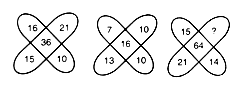
What should come in place of the question mark (?) in the following sequence:
Detailed Explanation:
Pattern: In each figure, the difference between upper two numbers equals the difference between lower two numbers.
First figure: Upper: 21 – 16 = 5; Lower: 15 – 10 = 5 ✓
Second figure: Upper: 10 – 7 = 3; Lower: 13 – 10 = 3 ✓
Third figure: Upper: 21 – 14 = 7; Lower: ? – 15 = 7, so ? = 22
🧐 Not Sure What to Study Next?
Get a personalised study plan based on your goals, time and revision needs.
Which Amendment to the Constitution abolished the two seats that were reserved for the Anglo-Indian community?
Detailed Explanation:
The 104th Constitutional Amendment Act, 2019 abolished the reservation of two seats for the Anglo-Indian community in the Lok Sabha and State Legislative Assemblies.
Originally provided under Articles 331 and 333, this nomination provision came into effect from 25 January 2020, ending a post-independence legacy that allowed Presidential and Gubernatorial nominations of Anglo-Indians to legislatures.
The meter that is used to measure the distance moved by the vehicle is known as:
Detailed Explanation:
Odometer is the instrument that measures the total distance traveled by a vehicle, displayed in kilometers or miles on the dashboard.
Ammeter measures electric current, Speedometer measures instantaneous speed, and Chronometer measures precise time.
When was the undersea cable-based Chennai-Andaman and Nicobar (CANI) Project inaugurated and dedicated to the nation by PM Narendra Modi?
Detailed Explanation:
The Chennai-Andaman and Nicobar Islands (CANI) undersea cable project was inaugurated by Prime Minister Narendra Modi on August 10, 2020.
The 2,312 km submarine optical fiber cable connects Chennai to Port Blair, Little Andaman, Car Nicobar, Kamorta, Great Nicobar, Long Island, and Rangat, providing high-speed broadband connectivity to enhance e-governance, telemedicine, education, and tourism in the islands.
Which of the following rulers ruled Assam in the time of Harsha?
Detailed Explanation:
Bhaskar Varman of the Varman dynasty ruled Kamarupa (Assam) during Harsha's reign (606-647 CE). He was a contemporary and ally of Emperor Harsha, attended the Kannauj Assembly, and is mentioned in Harshacharita by Bana Bhatta and accounts of Xuanzang.
Aswad Jahan was a medieval Muslim ruler, King Dahir ruled Sindh (not Assam), making Option 2 the only correct answer.
Which of the following acids is secreted in the stomach?
Detailed Explanation:
Hydrochloric acid (HCl) is secreted by parietal cells in the gastric glands of the stomach.
It activates pepsinogen to pepsin for protein digestion, kills ingested bacteria, and maintains a pH of 1.5–3.5 in the stomach.
Which of the following is a technopolis?
Detailed Explanation:
Technopolis is a city or region specifically designed and developed to support high-tech industries, research institutions, and innovation ecosystems.
Silicon Valley (California, USA) is the world's most famous technopolis, housing major IT companies (Google, Apple, Facebook), venture capital firms, and Stanford University. London, Paris, and Moscow are traditional capital cities with diverse economies but lack the focused high-tech infrastructure characteristic of a technopolis.
Dalton's atomic theory successfully explained:
i. Law of conservation of mass
ii. Law of constant composition
iii. Law of radioactivity
iv. Law of multiple proportion
Detailed Explanation:
Dalton's atomic theory (1808) explained three fundamental laws of chemical combination:
✅ Law of conservation of mass: Atoms are neither created nor destroyed in reactions, so total mass remains constant.
✅ Law of constant composition: A compound always contains the same elements in fixed proportions by mass.
✅ Law of multiple proportions: When two elements form multiple compounds, mass ratios are simple whole numbers.
❌ Law of radioactivity: Radioactivity (discovered by Becquerel, 1896) involves nuclear changes, not explained by Dalton's indivisible atom concept.
70th BPSC Prelims 2024 Questions Paper - Subject-wise Question Distribution
Current Affairs
34 Qs (22.7%)Bihar Special
27 Qs (18%)General Science
23 Qs (15.3%)Modern History
16 Qs (10.7%)Indian Polity
12 Qs (8%)General Mental Ability
10 Qs (6.7%)Indian Geography
8 Qs (5.3%)World Geography
7 Qs (4.7%)Ancient History
4 Qs (2.7%)Indian Economy
4 Qs (2.7%)Medieval History
3 Qs (2%)Indian Art & Culture
1 Qs (0.7%)Environment & Ecology
1 Qs (0.7%)70th BPSC Prelims 2024 Question Paper - FAQs & Analysis
Q1 How many total questions were asked in 70th BPSC Prelims 2024?
Q2 What is the subject-wise question breakdown for 70th BPSC Prelims 2024?
- Current Affairs: 34 questions (22.7%)
- Bihar Special: 27 questions (18%)
- General Science: 23 questions (15.3%)
- Modern History: 16 questions (10.7%)
- Indian Polity: 12 questions (8%)
- General Mental Ability: 10 questions (6.7%)
- Indian Geography: 8 questions (5.3%)
- World Geography: 7 questions (4.7%)
- Ancient History: 4 questions (2.7%)
- Indian Economy: 4 questions (2.7%)
- Medieval History: 3 questions (2%)
- Indian Art & Culture: 1 questions (0.7%)
- Environment & Ecology: 1 questions (0.7%)