
BPSC CCE Prelims
Verbal Reasoning Previous Year Questions (PYQs)
Showing solved Previous Year Questions for Chapter: Verbal Reasoning
Topic Breakdown: Scroll →
SPRING is written in a code as UNUFRC. How will the word MOBILE be mentioned in that code language?
Detailed Explanation:
Pattern: Alternating addition and subtraction of increasing numbers: +2, –2, +3, –3, +4, –4.
SPRING → UNUFRC: S (+2) = U, P (–2) = N, R (+3) = U, I (–3) = F, N (+4) = R, G (–4) = C.
MOBILE: M (+2) = O, O (–2) = M, B (+3) = E, I (–3) = F, L (+4) = P, E (–4) = A → OMEFPA.
Mukesh said to his friend, "Rita is the mother of my son's wife's daughter". How is Mukesh related to Rita?
Detailed Explanation:
My son's wife = Mukesh's daughter-in-law.
My son's wife's daughter = Mukesh's granddaughter.
Rita is the mother of this granddaughter, so Rita is Mukesh's daughter-in-law.
Therefore, Mukesh is Rita's father-in-law.
Ram goes North, turn right, then goes right again and then goes to left. In which direction Ram is now?
Detailed Explanation:
Initial Direction: Ram starts facing North.
First Right Turn: From North, turning right means facing East.
Second Right Turn: From East, turning right means facing South.
Left Turn: From South, turning left means facing East.
Final Direction: Ram is now facing EAST.
🧐 Not Sure What to Study Next?
Get a personalised study plan based on your goals, time and revision needs.
Writing in Alphabetical order, which name of the following will appear in the last?
Detailed Explanation:
Alphabetical order is determined by comparing letters from left to right until a difference is found.
Comparing all four names: Mahendra and Mahinder start with "Ma", while Mohender and Mohinder start with "Mo". Since "o" comes after "a", the "Mo" names appear later.
Between Mohender and Mohinder: after the common prefix "Moh", we compare "e" vs "i". Since "i" comes after "e" in the alphabet, Mohinder appears last.
Nitin is 7 ranks ahead of Joginder in a class of 39. If Joginder's rank is 17th from the last, what is Nitin's rank from the beginning?
Detailed Explanation:
Joginder's rank from beginning = 39 - 17 + 1 = 23rd.
Nitin is 7 ranks ahead means Nitin has a better (lower) rank number: 23 - 7 = 16th.
Find the missing number from the given alternatives:
| 28 | 20 | 7 |
| 84 | ? | 12 |
| 45 | 25 | 9 |
Detailed Explanation:
Pattern: Middle number = (First number ÷ Third number) × 5
Row 1: 28 ÷ 7 = 4, then 4 × 5 = 20 ✓
Row 3: 45 ÷ 9 = 5, then 5 × 5 = 25 ✓
Row 2: 84 ÷ 12 = 7, then 7 × 5 = 35
Answer: 35
RAIN is written in a code as 8%6 and MORE is mentioned as 7#8@. How will REMAIN be mentioned in code language?
Detailed Explanation:
Step 1 – Decode the given codes:
RAIN = 8%6 → R=8, A=%, N=6 (only 3 symbols for 4 letters, so I is omitted)
MORE = 7#8@ → M=7, O=#, R=8, E=@
Step 2 – Code REMAIN:
R=8, E=@, M=7, A=%, I=(omitted), N=6
REMAIN → 8@7%6
If C is brother of B, B is son of A, DD is father of C and A is female, then A is
Detailed Explanation:
B is the son of A, and A is female, so A is B's mother.
C is the brother of B, meaning C and B share the same parents; thus A is also C's mother.
D is the father of C, and since C and B have the same parents, D is the father of both C and B.
Therefore, A (mother) and D (father) are married, making A the wife of D.
CIRCLE is related to RICELC in the same way SQUARE is related to
Detailed Explanation:
The pattern splits the word into two equal halves, reverses each half, then joins them.
CIRCLE → split into CIR and CLE → reverse to RIC and ELC → combine as RICELC.
SQUARE → split into SQU and ARE → reverse to UQS and ERA → combine as UQSERA.
Raj travelled from a point X straight to Y at a distance of 80 metres. He turned right and walked 50 metres, then again turned right and walked 70 metres. Finally, he turned right and walked 50 metres. How far is he from the starting point?
Detailed Explanation:
Raj's movement from point X:
80 metres straight (assume East) → position (80, 0)
Right turn, 50 metres (South) → position (80, -50)
Right turn, 70 metres (West) → position (10, -50)
Right turn, 50 metres (North) → final position (10, 0)
Distance from X: Horizontal displacement = 10 metres, Vertical displacement = 0 metres
Answer: 10 metres
What should come in place of the question mark (?) in the following sequence:
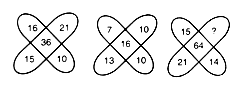
Detailed Explanation:
Pattern: In each figure, the difference between upper two numbers equals the difference between lower two numbers.
First figure: Upper: 21 – 16 = 5; Lower: 15 – 10 = 5 ✓
Second figure: Upper: 10 – 7 = 3; Lower: 13 – 10 = 3 ✓
Third figure: Upper: 21 – 14 = 7; Lower: ? – 15 = 7, so ? = 22
What is the 14th term of the sequence 14, 10, 6, 2...?
Detailed Explanation:
Arithmetic Progression (AP): The sequence 14, 10, 6, 2... has first term a₁ = 14 and common difference d = -4.
Using the nth term formula aₙ = a₁ + (n-1)d, the 14th term a₁₄ = 14 + (14-1)(-4) = 14 + 13×(-4) = 14 - 52 = -38.
In a certain code language COMPUTER is written as RFUVQNPC. How will MEDICINE be written in that code language?
Detailed Explanation:
Coding Pattern: Reverse the word, then shift each middle letter (excluding first and last) +1 position in the alphabet.
COMPUTER: Reverse → RETUPMOC → Keep R, shift ETUPMO (+1 each) → RFUVQNP, keep C → RFUVQNPC.
MEDICINE: Reverse → ENICIDEM → Keep E, shift NICide (+1 each: N→O, I→J, C→D, I→J, D→E, E→F) → EOJDJEF, keep M → EOJDJEFM.
Gaurav walks 20 metres towards North. He then turns left and walks 40 metres. He again turns left and walks 20 metres. Further, he moves 20 metres after turning to the right. How far is he from his original position?
Detailed Explanation:
Starting point: (0, 0)
20 m North: Position becomes (0, 20)
Turn left (West), 40 m: Position becomes (−40, 20)
Turn left (South), 20 m: Position becomes (−40, 0)
Turn right (West), 20 m: Position becomes (−60, 0)
Final displacement: 60 metres from the original position (straight-line distance along the x-axis).
Choose the group of letters which is different from others.
Detailed Explanation:
ORUX: O(15)→R(18)→U(21)→X(24) gives differences of +3, +3, +3
PSVX: P(16)→S(19)→V(22)→X(24) gives differences of +3, +3, +2 (last gap breaks pattern)
CFIL: C(3)→F(6)→I(9)→L(12) gives differences of +3, +3, +3
JMPS: J(10)→M(13)→P(16)→S(19) gives differences of +3, +3, +3
Three groups maintain constant +3 difference, while PSVX has +2 in final step, making it the odd one out.
Showing 1 to 15 of 19 questions